How Young Children Understand Social Chatbots: Anthropomorphism, Brain Responses, and Parent Co-Use
Published
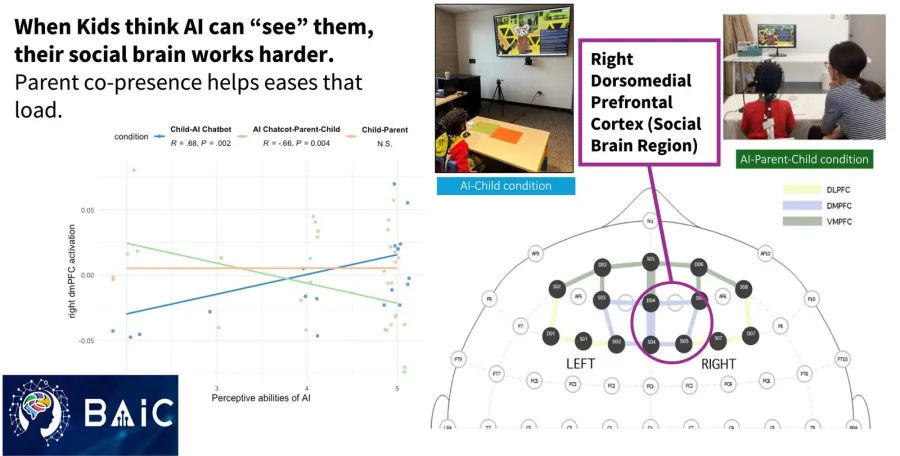
Young children readily treat conversational agents as social beings. This study examines that anthropomorphism directly — combining children’s behavior, their brain activation, and the influence of a parent being present during the interaction.
Research question
How do young children attribute human-like qualities to an AI conversational agent, what does their brain activation reveal about how they process it socially, and how does a parent’s co-presence shape that experience?
Approach
Children interact with an AI-powered conversational agent while we measure anthropomorphism and neural responses, comparing conditions in which a parent is and is not co-present.
Why it matters
Parents are often the gateway through which young children meet AI. Understanding how co-presence shapes a child’s developing model of what an AI “is” can guide healthier family practices and better-designed agents for young users.