
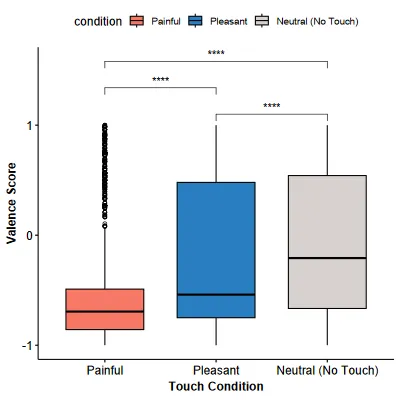
As robots become more present in daily life, a basic question emerges: do people respond to a robot’s apparent pain the way they respond to a human’s? This two-part study uses functional near-infrared spectroscopy (fNIRS) to measure neural responses while participants observe human versus robot pain.
Approach
- Study 1 (n = 63) measured cortical responses to images and scenarios depicting human and robot pain.
- Study 2 (n = 39) extended the paradigm to examine how individual differences shape empathic responding toward robots.
Why it matters
Understanding how and when humans extend empathy to machines informs how we design robots and AI companions for children — and helps us anticipate the social and emotional dynamics that emerge when young people relate to machines that appear to feel.