Understanding Children and Adolescents in the Age of AI
The Brain, AI, and Child (BAIC) Center studies how AI chatbots and other AI systems are shaping young people's relationships, development, and wellbeing across home, school, and online life.
What We Study
BAIC brings a developmental-science lens to the questions raised by AI in young people's lives.

AI–Child Relationships & Social Connection
How children and adolescents form social and emotional relationships with AI chatbots and companions.

Child Safety & Responsible AI
Understanding risks and designing guardrails so AI supports rather than harms young people.

AI & Mental Health and Wellbeing
How AI affects stress, support-seeking, emotional reliance, and psychological wellbeing.

Real-World Impact
Translating developmental science into guidance for families, schools, policymakers, and developers.
Our Research Mission
At the Brain, AI, and Child (BAIC) Center, we study how AI chatbots are influencing the lives, minds, and relationships of today’s children and adolescents. Our research examines how young people understand, trust, rely on, and relate to AI and what these experiences mean for emotional well-being, social development, and mental health. Using developmental science methods, including experiments, behavioral observation, surveys, and neuroimaging, we investigate how AI transparency, emotional style, and anthropomorphic cues shape youth experiences. Our goal is to generate evidence that informs safer, developmentally appropriate practices and policies for families, educators, policymakers, and technology developers.
More About UsResearch
A selection of our active and published studies on children, adolescents, and AI.
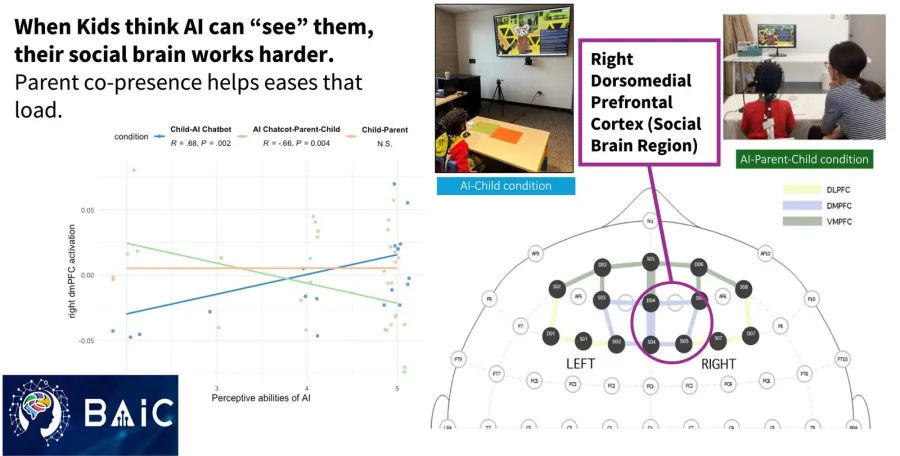
How Young Children Understand Social Chatbots: Anthropomorphism, Brain Responses, and Parent Co-Use
How young children make sense of social chatbots — measured through anthropomorphism, brain activation, and the role of a parent present alongside.
Learn more →
In-Lab Teen–Chatbot Conversations: Relational vs Transparent Styles and Social Stress
How a chatbot's conversational style — warm and relational versus clearly transparent — shapes teens' experience of social stress.
Learn more →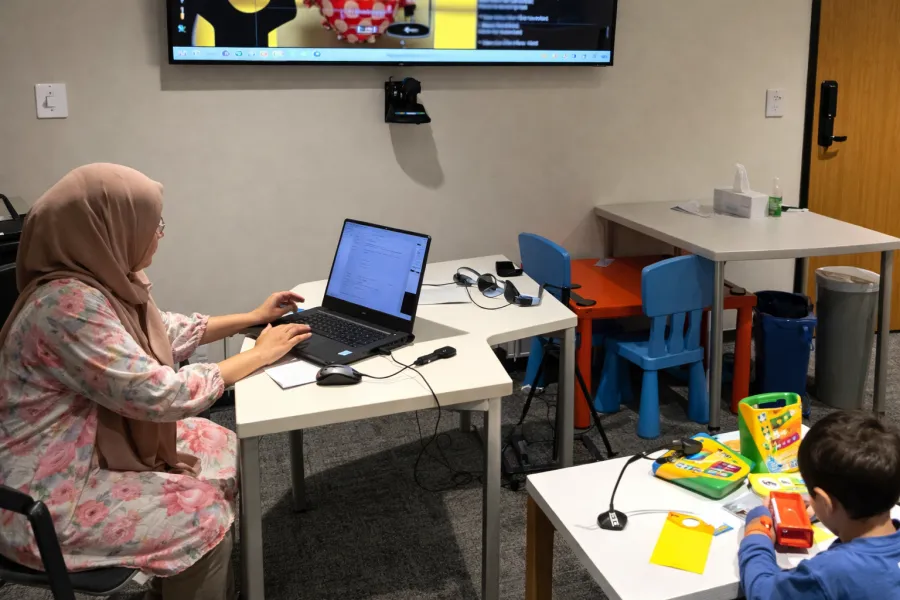
Creativity and Social Communication in Child–AI Storytelling
Watching how children create stories together with an AI partner — and what it reveals about creativity and communication.
Learn more →
Measuring Youth Overreliance on AI: A Developmentally Appropriate Dependency Scale
Building a validated scale to measure when young people's reliance on AI tips into unhealthy dependency.
Learn more →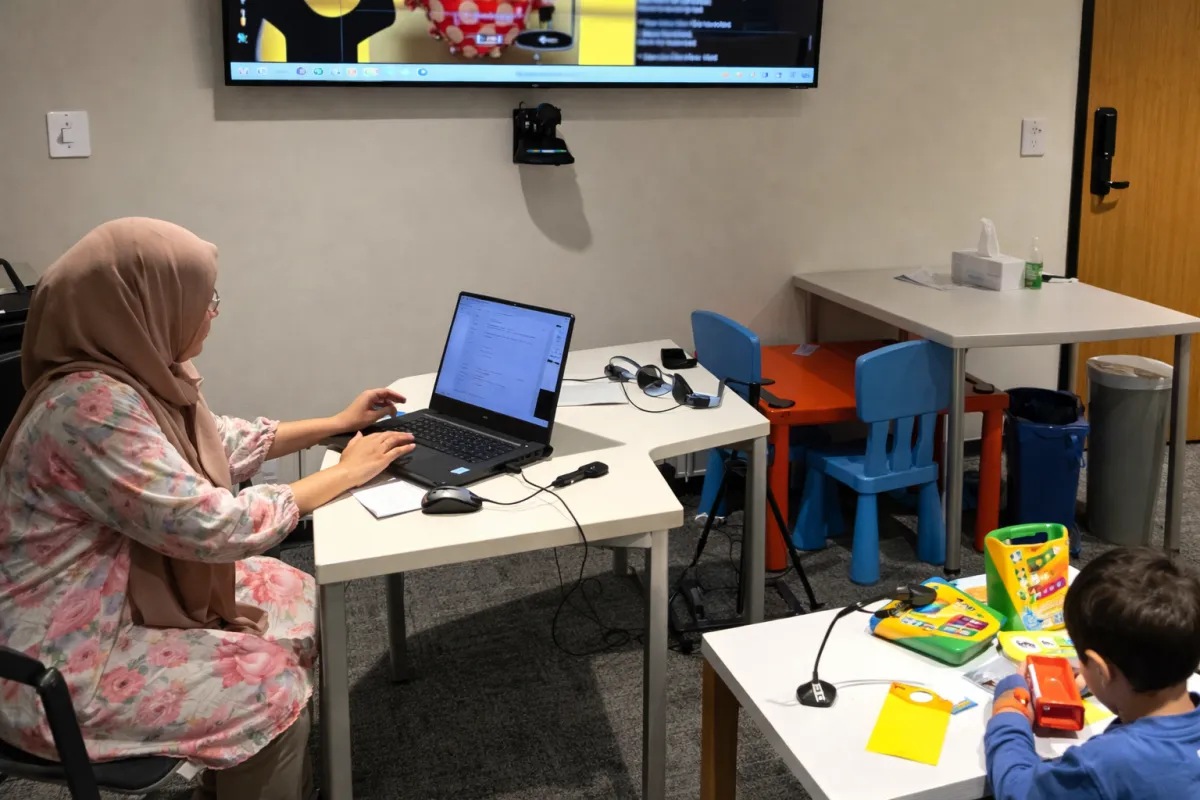


Why This Research Matters
AI is increasingly entering young people's social and emotional lives. Children and adolescents are not just using AI for information. They may turn to it for comfort, advice, affirmation, creativity, and companionship. Yet we still know very little about how these interactions affect development, human relationships, and well-being. BAIC addresses this gap by bringing developmental science to one of the most pressing challenges of the AI era — understanding when AI may support young people, when it may introduce risks, and how adults and institutions can respond with evidence rather than assumptions.
Social & Emotional AI Literacy
SEAL is a framework for helping youth critically understand AI in social and emotional contexts. It addresses questions such as why AI can feel human, when AI may be helpful, when human support is needed, and how young people can protect their well-being, relationships, privacy, and rights.
Families
Guidance for navigating children's AI use at home.
Educators
Evidence for classroom, school, and youth settings.
Policymakers
Research to inform child-centered AI policy and safety conversations.
Developers & Tech Leaders
Evidence on youth AI experiences, developmental risks, and wellbeing outcomes.
See Our Research
Explore how we study children and adolescents growing up alongside AI — and what it means for their development and wellbeing.
More about us